Behavioral Economics in Wagering: How Decision Frameworks Shape Outcomes in Regulated Settings
Written by Otto Hughes · Aug 19, 2026
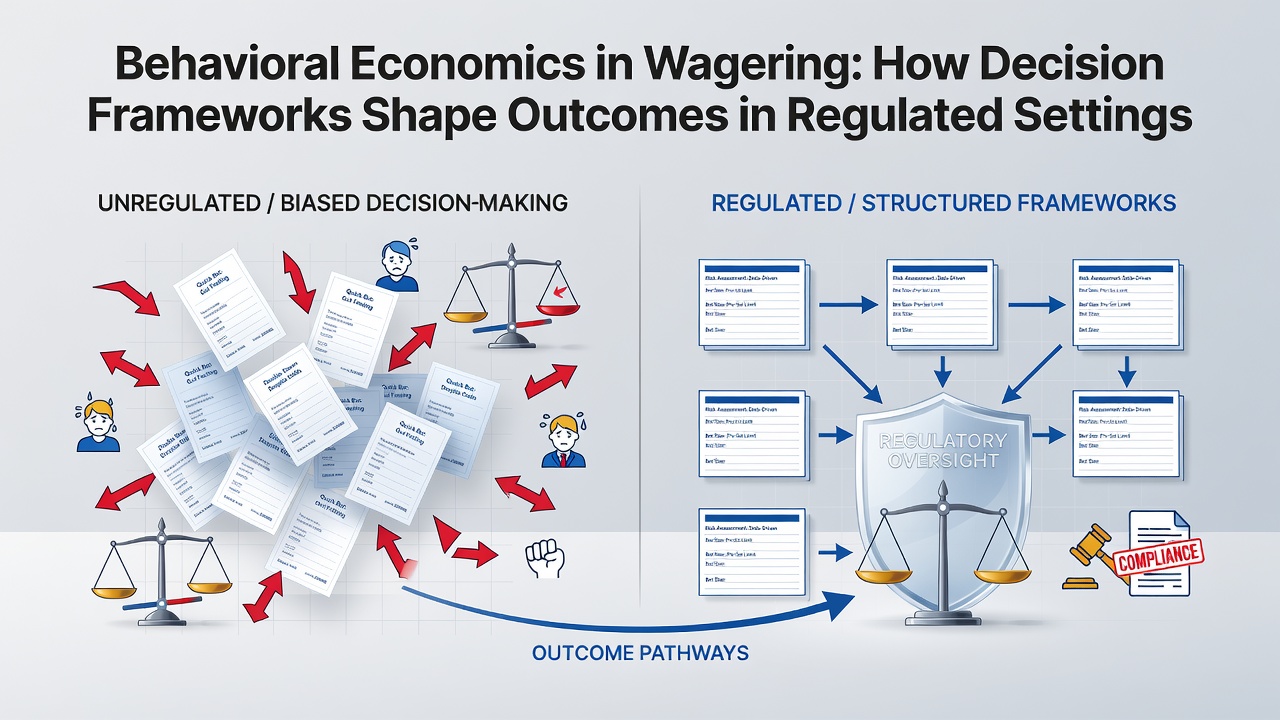
Behavioral Economics in Wagering: How Decision Frameworks Shape Outcomes in Regulated Settings
Behavioral economics applies psychological insights to economic decision-making, and its principles appear throughout wagering activities where individuals evaluate risks and rewards under structured rules. In regulated environments operators must comply with oversight from bodies such as the Nevada Gaming Control Board and the Australian Gambling Research Centre, which collect data showing how cognitive biases influence player behavior across lotteries, sports betting, and table games.
Core Concepts from Prospect Theory in Wagering Contexts
Daniel Kahneman and Amos Tversky developed prospect theory in 1979, demonstrating that people weigh potential losses more heavily than equivalent gains, a pattern researchers continue to observe in betting data. Studies indicate that when odds are presented as chances to recover prior losses rather than opportunities for new gains, participation rates rise even when expected value remains negative. Regulators in multiple jurisdictions require clear disclosure of house edges precisely because this loss-aversion tendency can extend session length beyond what mathematical probabilities alone would predict.
Framing effects further modify choices. When the same probability appears as a 70 percent chance of losing versus a 30 percent chance of winning, selection patterns shift measurably according to records maintained by the Ontario Lottery and Gaming Corporation. These shifts occur consistently across demographic groups, suggesting structural features of how information reaches players rather than individual traits alone.
Heuristics and Biases Observed in Regulated Markets
Availability bias leads individuals to overestimate the likelihood of large wins after recent media coverage of jackpots. Data compiled by the National Council on Problem Gambling in the United States shows spikes in lottery ticket sales immediately following publicized drawings, even though the probability of matching all numbers stays constant. Operators subject to advertising standards must therefore balance promotional activity with required responsible-gambling messaging to offset this distortion.
Anchoring occurs when initial odds or minimum bet amounts serve as reference points. Research published in the Journal of Gambling Studies reveals that players adjust subsequent wagers around the first figure they encounter, regardless of updated information provided later in the session. Regulated platforms address this pattern through mandatory display of updated probabilities and session histories that reduce reliance on a single anchor.

Regulatory Responses and Structural Safeguards
Authorities in Canada and Australia have introduced mandatory pre-commitment systems that require players to set deposit and time limits before play begins. These tools interrupt the escalation pattern associated with the sunk-cost fallacy, where continued betting stems from resources already committed rather than current expected value. Evaluations conducted by the Australian Institute of Criminology indicate measurable reductions in extended play sessions following implementation of such systems.
Default options also shape outcomes. When responsible-gambling tools appear as opt-in features, uptake remains low; when they function as opt-out defaults, engagement increases substantially according to field experiments reported by the European Gaming and Betting Association. Regulators therefore adjust interface requirements to align with observed default bias rather than assuming fully deliberative choices.
Interaction Between Market Design and Cognitive Patterns
Speed of play influences the frequency of decision points and thereby amplifies certain biases. Electronic gaming machines with rapid reel cycles allow more repetitions within a fixed period, increasing exposure to near-miss events that reinforce continued play. The Nevada Gaming Control Board collects machine performance data showing that regulatory caps on spin rates correlate with changes in average session duration across licensed venues.
Information presentation standards further mediate bias effects. Requirements for real-time display of net winnings rather than gross amounts counteract the tendency to focus only on wins while underweighting losses. Multiple jurisdictions now mandate this format after pilot programs demonstrated shifts in player stopping behavior when loss information receives equal visual weight.
Conclusion
Behavioral economics supplies a framework for understanding systematic patterns in wagering decisions that persist across regulated markets. Data from oversight agencies and academic researchers demonstrate that loss aversion, anchoring, availability, and default effects operate consistently when individuals interact with structured betting environments. Regulatory measures such as pre-commitment tools, interface defaults, and probability disclosures represent direct responses to these documented tendencies rather than assumptions of purely rational calculation. As new data emerge from ongoing monitoring by bodies including the Nevada Gaming Control Board and the Australian Gambling Research Centre, structural adjustments continue to evolve in line with empirical observations of how decision frameworks shape participation and outcomes.