Cognitive Dissonance Effects on Poker Players Choices in Long Sessions
Written by Morgan Perry · Jul 22, 2026
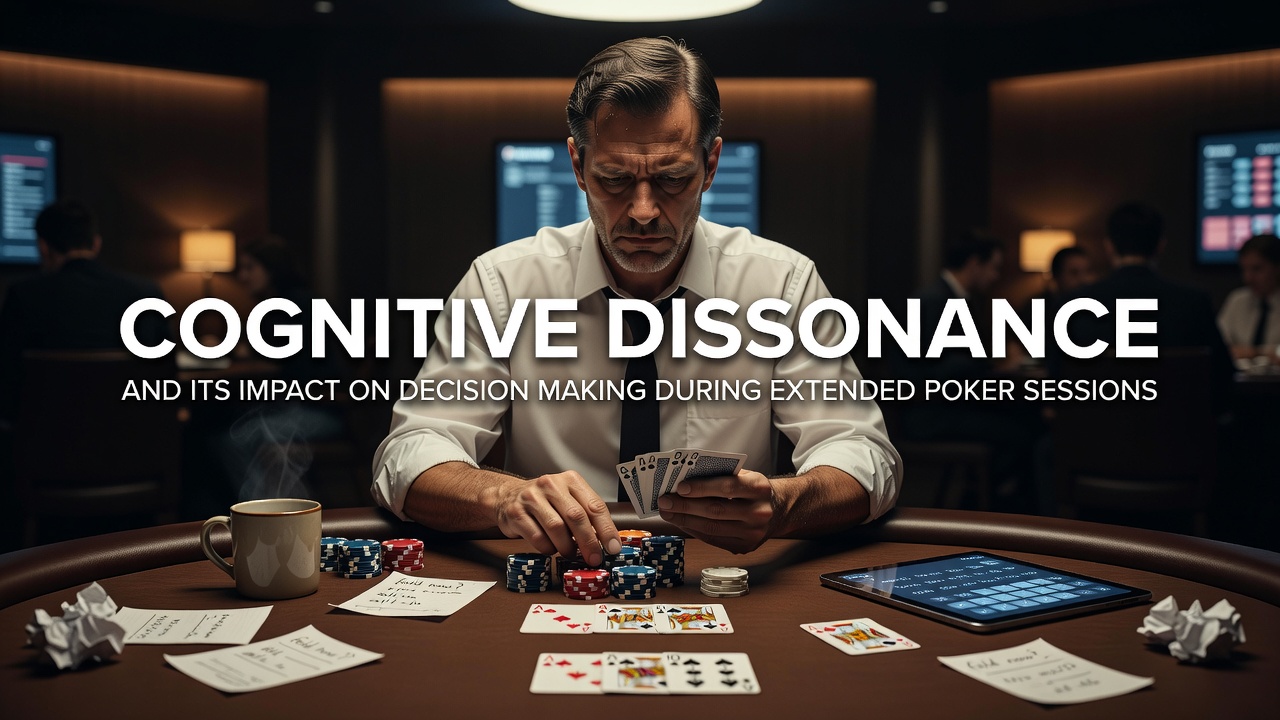
Cognitive Dissonance Effects on Poker Players Choices in Long Sessions
Cognitive dissonance arises when individuals hold conflicting beliefs or when their actions contradict their knowledge, creating psychological tension that people naturally seek to resolve. In poker environments this tension often surfaces during extended sessions where losses accumulate and decisions deviate from established strategies. Researchers have documented how players rationalize continued participation or altered betting patterns to ease the discomfort, and data from multiple studies indicate measurable shifts in risk assessment after four or more hours at the table.
Core Mechanisms of Cognitive Dissonance
Leon Festinger introduced the concept in 1957, describing the mental strain that occurs when new information clashes with prior convictions. Observers note that poker participants frequently encounter this strain after folding strong hands only to see favorable cards appear, or after calling large bets that later prove costly. The resulting discomfort prompts attempts to align behavior with self-image, such as viewing a loss as an investment rather than an error. Studies published through academic channels show that resolution often takes the form of selective memory, where players recall winning moments more vividly while downplaying recent setbacks.
Manifestation During Prolonged Play
Extended poker sessions amplify these effects because fatigue reduces the brain's capacity to maintain consistent reasoning. Players who enter a tournament with strict bankroll limits may gradually increase stakes after a series of unfavorable outcomes, justifying the change by recalling earlier successes in the same session. Data collected from online platforms reveal that average bet sizes rise noticeably between the fourth and sixth hour of continuous play, coinciding with periods when cognitive resources are depleted. This pattern appears across both live and virtual formats, suggesting the underlying psychological process operates independently of physical setting.
Decision Making Patterns Observed in Research
Evidence from controlled experiments demonstrates that participants exposed to repeated losses adjust their evaluation criteria mid-session. One study tracked college students in simulated poker environments and found that after experiencing dissonance-inducing outcomes, subjects rated marginal hands as stronger than they had at the start. The shift allowed them to maintain an internal narrative of skill rather than chance. Regulatory analyses from bodies such as the National Council on Problem Gambling in the United States have noted similar adjustments in self-reported data submitted by frequent players. Meanwhile, reports compiled by the Australian Gambling Research Centre indicate that session length correlates with increased chasing behavior, defined as placing larger wagers to recover prior losses.

Those who have reviewed hand histories from major online operators report that fold frequencies decline in later stages of long tournaments, even when statistical models recommend tighter play. The change aligns with efforts to reduce dissonance by remaining active rather than sitting out hands that might reinforce a losing narrative. Physiological measurements taken during lab-based sessions further show elevated cortisol levels during these periods, indicating sustained stress that compounds the original psychological conflict.
Role of External Factors and Session Dynamics
Environmental elements such as table talk, alcohol availability, and time-of-day pressures interact with internal dissonance. Research teams in Canada have documented how verbal justifications exchanged between players can reinforce collective rationalizations, making it harder for any single participant to exit. Figures from the Canadian Centre on Substance Use and Addiction reveal that players who remain seated beyond six hours are more likely to cite sunk-cost reasoning when interviewed afterward. This reasoning functions as a dissonance-reduction strategy because it reframes continued investment as logical rather than impulsive.
Seasonal variations also appear in aggregated data. During peak summer months when major series occur, longer average session durations coincide with higher reported instances of post-session regret among recreational participants. Although July 2026 schedules for several large circuits have already been released, early indicators suggest similar patterns will hold based on historical trends from comparable events.
Measurement and Identification Approaches
Psychologists employ standardized scales to quantify dissonance levels before and after simulated poker tasks. These instruments capture shifts in attitude toward risk and self-perception of control. Industry analysts have adapted portions of these scales for player-tracking software, allowing operators to flag accounts displaying rapid increases in aggression metrics during extended login periods. The resulting alerts help differentiate between strategic adjustments and dissonance-driven changes, although implementation remains uneven across jurisdictions.
Conclusion
Cognitive dissonance operates as a persistent influence on decision sequences throughout extended poker sessions, prompting adjustments in risk tolerance, memory recall, and self-justification. Data gathered from academic experiments, regulatory submissions, and platform analytics consistently illustrate these effects across different player populations and formats. Understanding the mechanisms provides a factual basis for recognizing when choices begin to diverge from initial plans, without requiring subjective interpretation of individual motivation.