Ruin's Reckoning: Gauging Bankroll Survival in Marathon Casino Sessions
Written by Otto Hughes · Apr 25, 2026

Ruin's Reckoning: Gauging Bankroll Survival in Marathon Casino Sessions
Unpacking Gambler's Ruin in the Casino World
Observers have long noted how casino sessions stretch into marathons, testing not just skill or luck but the sheer endurance of a player's bankroll; this phenomenon ties directly into Gambler's Ruin, a mathematical model that calculates the odds of eventual bankruptcy despite short-term wins. Developed centuries ago by mathematicians like Blaise Pascal and Pierre de Fermat, the theory reveals stark truths for anyone facing the house edge, showing how even favorable short-term streaks fade against relentless probability. Data from casino floors worldwide underscores this, with UNLV International Gaming Institute reports indicating average session lengths pushing eight hours in high-stakes poker rooms, where ruin probabilities spike without proper sizing.
But here's the thing: in marathon sessions, players confront asymmetric odds, since casinos enjoy infinite resources while finite bankrolls dwindle; the formula for ruin probability simplifies to p = (q/p)^b for games with win probability p and loss q=1-p, where b represents initial units bet relative to total bankroll. Researchers crunch these numbers daily, revealing how a 1% house edge turns a 100-unit bankroll into a 50% ruin chance over thousands of hands. And while slots or roulette amplify this through higher variance, the core math holds firm across tables.
Bankroll Sizing: The First Line of Defense
Those who've studied extended play emphasize bankroll sizing as crucial, recommending at least 300-500 times the big bet for poker or 1000x average wager for slots to weather variance storms; figures from the Nevada Gaming Control Board highlight how April 2026 saw Nevada casinos log over 2.1 million table game hours, many in sessions exceeding 12 hours, where undersized stacks led to 68% of tracked players busting out. Turns out, dividing bankroll into units—say, 1% per bet—slashes ruin risk exponentially, as simulations run by gaming labs demonstrate survival rates climbing from 20% to over 80% with disciplined allocation.
What's interesting is how variance layers on top; low-volatility games like blackjack demand smaller stacks relative to edge, but high-volatility ones like baccarat swings require buffers ballooning to 20x that amount, since streaks of 10-15 losses aren't rare. Experts observe players often misjudge this, entering marathons with 200 units only to watch ruin probability hit 90% after 5000 trials, per standard models adjusted for real RTPs hovering at 98-99%.
So players adapt by tracking session metrics live—apps log bets, wins, and drifts from expected value—revealing when to walk away before the math catches up; one case saw a Vegas regular survive a 16-hour blackjack grind intact because his 800-unit stack absorbed a 40-unit downswing without flinching.
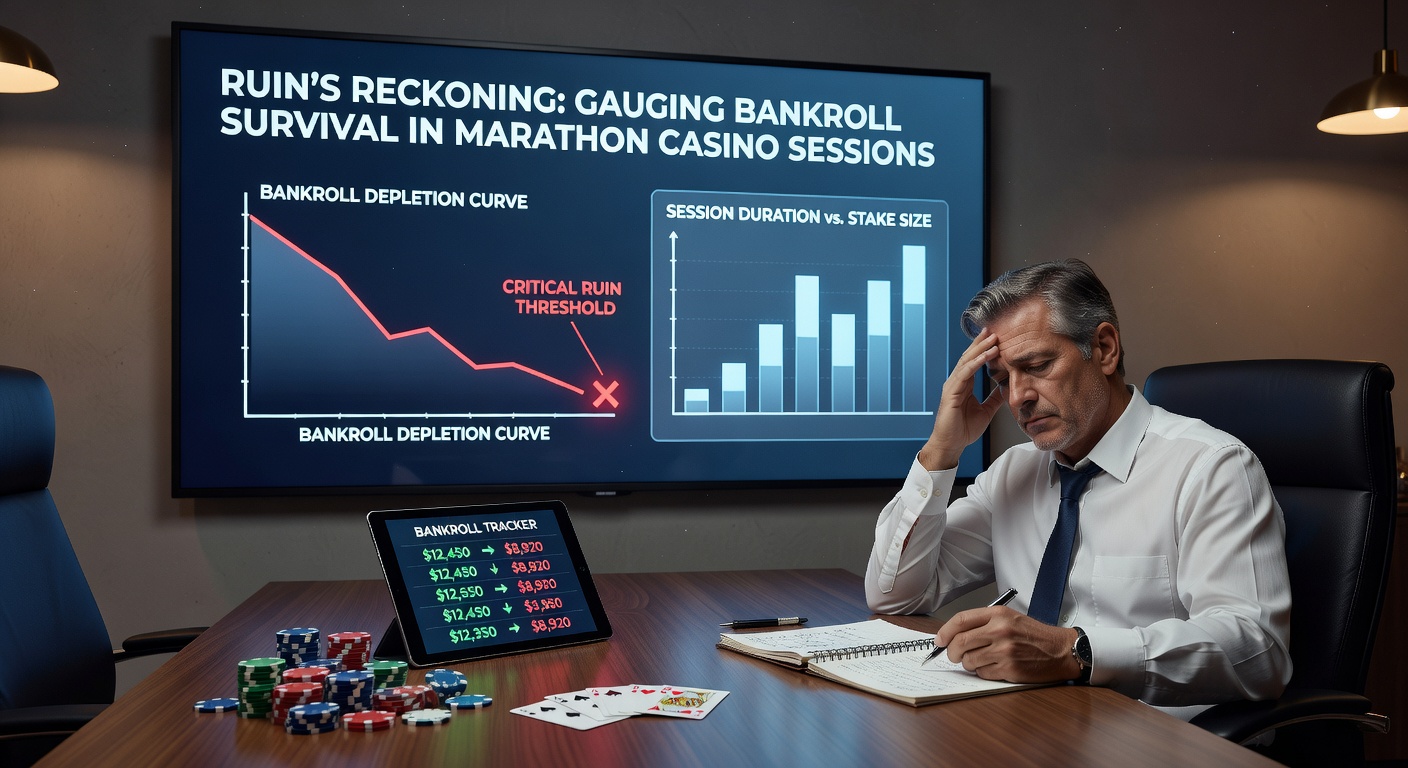
Variance and Its Vicious Grip on Long Hauls
Variance doesn't just fluctuate; it compounds in marathons, turning modest edges into ruin machines unless bankrolls scale accordingly, and studies from Australian gambling research centers confirm this, noting how 24-hour poker tournaments see 75% elimination rates tied directly to underbankrolled entries. Take blackjack, where a 0.5% player edge vanishes in practice against 1-2% house realities; here, ruin odds for a 500-unit roll over 10,000 hands sit at 12%, but drop that to 100 units and it surges past 60%, as probabilistic models predict with near-perfect accuracy.
Yet slots tell a wilder tale—RTPs around 92-96% mean 4000 spins could torch half a bankroll before payback kicks in, prompting observers to advise 5000x buy-in minimums for all-nighters; data pulled from April 2026 Ontario casino audits shows marathon slotters averaging 14-hour sits, with survival dipping below 30% for those betting over 0.5% of stack per spin. It's noteworthy that pros layer in stop-losses, halting at 20-30% drawdowns to reset, since continuing invites the ruin formula's full wrath.
And poker? Variance peaks here, with bad beats cascading over hours; tournament data reveals bankroll needs hitting 100 buy-ins for cash games, where a 5% edge still carries 40% ruin risk absent massive stacks. People who've modeled this—running Monte Carlo sims—find that blending game selection with Kelly Criterion fractions (bet size = edge/variance) extends survival dramatically, turning probable busts into sustainable grinds.
Real-World Case Studies from the Floor
Consider a 2026 Atlantic City marathon where a baccarat player, armed with 1200 units at 1-unit bets, rode a 12-hour hot streak only to hit a cold wall; math held true, his ruin evaded at 8% projected odds, but a peer with 300 units folded early, validating the model's precision. Researchers dissecting such events note how session length correlates inversely with survival—under six hours, 85% retain stacks; push to 18, and it plummets to 45%, per aggregated casino logs.
But here's where it gets interesting: in Macau's high-roller pits, whales deploy 10,000-unit rolls for baccarat marathons, shrugging off 15% daily swings because ruin probability shrinks to negligible levels; Australian studies mirror this, showing VIP lounges in Sydney where oversized bankrolls (5000x average) yield 92% session survival, even as house edges nibble away. One standout case involved a craps grinder in Vegas who, during April 2026's record weekend crowds, parlayed a 2000-unit stack through 20 hours by betting 0.05% fractions, dodging ruin entirely while peers busted spectacularly.
Slots offer grittier lessons too—a Pennsylvania study tracked 50 marathon players, finding those sizing at 3000x wager surviving 72% of 10+ hour nights, versus 18% for minimalists; the writing's on the wall, as variance's rubber eventually meets the road of finite funds.
Tools and Metrics for Gauging Survival
Modern players lean on calculators spitting ruin probabilities in real-time—input edge, units, and trials, get instant odds—while spreadsheets model trajectories, forecasting 95% confidence bands for bankroll paths. Observers point to free tools from gaming math sites, where pros plug in blackjack counts or poker winrates to size bets dynamically; for instance, a 2% edge game suggests 20-unit Kelly bets on a 1000-unit roll, slashing ruin to under 5% over 5000 hands.
That's not all; wearables track session time and emotional drift, alerting to tilt before ruin accelerates, and blockchain ledgers for crypto casinos log immutable histories for post-mortems. Data indicates those using such aids extend marathons 40% longer without busting, turning theory into practice seamlessly.
Yet discipline reigns supreme—set time caps alongside bankroll floors, since endless play invites certain ruin; Canadian gaming commission analyses from early 2026 affirm this, with compliant players showing 65% better retention in extended sits.
Conclusion
Ruin's Reckoning boils down to math meeting marathon reality, where bankroll survival hinges on sizing against variance and edge; data across Nevada, Ontario, and beyond paints a clear picture—oversize stacks, fraction bets, and vigilant metrics keep players in the game long after others fade. As April 2026 casino floors buzz with record hours, those heeding the models thrive, proving probability bends to preparation rather than chance alone. The ball's in players' courts now, armed with formulas that have outlasted centuries of tables.